简体中文
简体中文

- FEATURE
- |
- MERGERS & ACQUISITIONS
- |
- FINANCIAL
- |
- MARKETING
- |
- RETAIL
- |
- ESG-SUSTAINABILITY
- |
- LIFESTYLE
- |
-
MORE




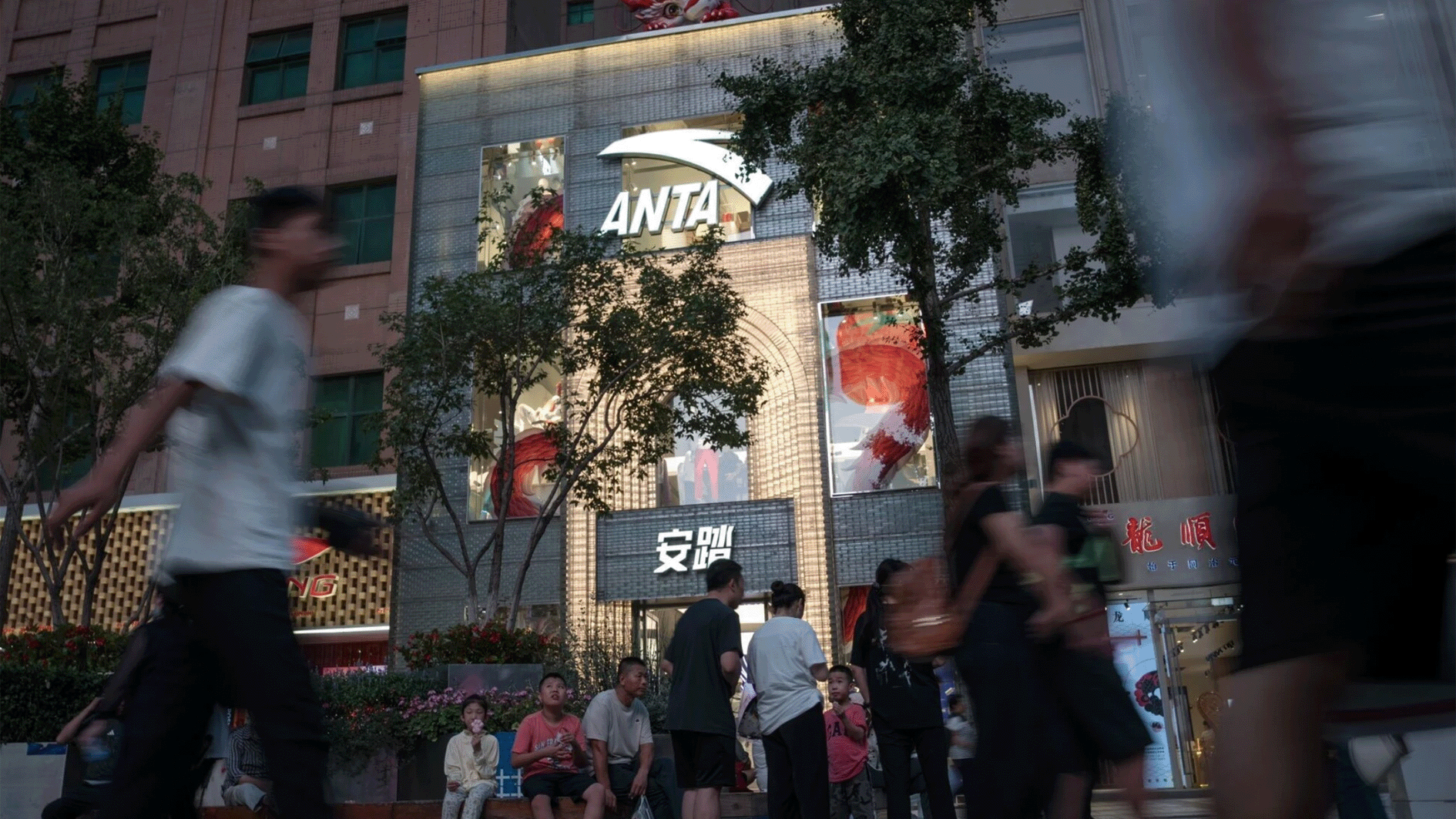
For a corporation of Anta’s size—now a one-trillion-yuan heavyweight—there is no slowing down. The tides of 2025 saw the group sailing through both smooth waters and turbulent waves. But every past experience now simply becomes fuel for the next phase of expansion. As a publicly listed consumer giant, Anta faces relentless pressure from investors craving ever-higher returns, media hungry for headlines, consumers chasing buzz, and its own institutional momentum and ambition. It has no room to hesitate, let alone drift or stall. Like any vessel moving against the current, if it isn’t advancing, it’s falling behind.
By the end of 2025, Anta’s performance had answered many questions—and raised new ones. According to its Q3 financials, both revenue and profit continued to grow steadily. The “Other Brands” category, which includes Descente and Kolon Sport, posted the strongest gains, emerging as a critical growth engine. Meanwhile, the Anta mainline and FILA saw low-single-digit growth.
This reflects a maturing multi-brand matrix, and marks Anta’s entry into a new phase—one driven less by aggressive expansion and more by nuanced operations and long-term brand building. But as history and current global business dynamics show, diversification doesn’t make management any easier. Instead, it demands sharper strategic focus and greater capacity to maintain brand independence. Now that Anta has crossed the 100-billion-yuan revenue milestone, its key challenge is no longer about scaling up, but rather how to sustain upward momentum—especially how to revitalize the group’s core brands.
2024 was the year when Anta, in combination with its international arm Amer Sports, officially joined the 100-billion club, becoming the third global sportswear conglomerate to do so after Nike and adidas. But the group's pace didn’t ease. The year was filled with strategic acquisitions, partnerships, and retail moves that demonstrated a hunger to strengthen and future-proof its global footprint.
In April, Anta announced its acquisition of German outdoor brand Jack Wolfskin for $290 million. This broadened its reach across the outdoor lifestyle spectrum, adding a more accessible and mass-oriented brand to complement its existing high-performance outdoor portfolio—including Arc’teryx, Descente, and Kolon. Together, these brands form a more resilient matrix, capable of weathering cyclical swings in demand.
Then in August, Anta struck another high-profile deal: partnering with leading Korean fashion platform MUSINSA, acquiring a 40% stake and launching a joint venture—MUSINSA China. On December 14, MUSINSA opened its first international flagship store in the heart of Shanghai, bringing its content-driven retail model and accessible fashion to China’s Gen Z shoppers. Born as an online magazine, MUSINSA blends e-commerce with culture and curates a portfolio of brands mostly priced under 1,000 RMB.
For Anta, investing in MUSINSA marked a strategic pivot. It signaled the group’s intention to test a different growth formula—beyond sports, beyond products. When content, culture, and platform dynamics start to outweigh traditional retail in shaping consumer behavior, understanding how younger consumers express their identity and make purchasing decisions becomes a vital brand capability. Anta has long excelled at the “brand + retail” model. MUSINSA, meanwhile, offers a gateway into a new world—“content + platform.” Their partnership lays the groundwork for a broader play: competing for the attention of future Chinese youth.
Adding further intrigue is MUSINSA’s rumored IPO. Reports suggest it may list as early as 2026, with an estimated valuation of 10 trillion KRW (approx. 48.1 billion RMB). Should this go through, Anta’s minority stake could yield outsized returns, financially and strategically.
It’s precisely this track record that fuels the perception of Anta as a savvy buyer—and one still on the lookout for its next big move. Rumors of a potential acquisition of Reebok or Puma resurfaced throughout 2025, with Bloomberg and Reuters reporting that Anta was evaluating the possibility of bidding for Puma. On the Reebok front, Anta has neither confirmed nor denied market speculation.
Whether or not these rumored deals materialize, the fact that they continue to circulate is telling. The market now sees Anta as a serious global consolidator with real M&A capability. Its every move is being watched not just for growth but for what it signals about structural ambitions.
At this level of scale, Anta’s continued expansion isn’t just about growth anxiety—it’s a response to structural pressure. Domestically, competition intensifies. Global brands are recalibrating and returning to China with sharper positioning. Product categories are splintering, consumer demographics are more fragmented than ever. Time for trial and error is shrinking. Investment and acquisitions offer optionality amid uncertainty.
And the data supports this urgency. In the first half of 2025, Anta’s revenue rose 14.3% year-on-year to 38.544 billion RMB. The Anta mainline grew 5.4% to 16.95 billion RMB. FILA posted an 8.6% increase to 14.182 billion RMB. But the “Other Brands” segment surged 61.1% to 7.412 billion RMB. Anta is still growing—but the momentum is shifting toward higher-end, higher-growth categories.
For the Anta mainline, the stakes are highest. It bears the group’s largest volume, serves the most diverse consumer base, and operates the most complex distribution network. Competitive pressure is fierce: domestic rivals are doubling down on both performance and style, while global players are stepping up efforts to win over mass consumers across categories like running, training, and lifestyle. Online retail dynamics are compounding the challenge—promotions can quickly distort pricing and perceptions of value. Anta must now find a fine balance between mass accessibility and brand prestige.
Its global expansion has also been measured but deliberate. Without the advantage of historical brand equity or cultural familiarity, Anta has chosen not to rush, but to enter new markets through concrete products, partnerships, and localized storytelling. In 2025, this approach became more visible, with key moves in New York, Paris, and Los Angeles—global hubs for fashion and commerce.
The partnership with NBA star Kyrie Irving has proven especially valuable. Basketball’s universal appeal gives Anta a shared language, while Irving’s crossover identity—athlete, street icon, creative collaborator—helps the brand establish cultural relevance. His signature line doesn’t focus solely on technical performance but also on everyday style, making it easier to enter the wardrobes of consumers beyond the court.
This strategic choice is revealing. For a Chinese sportswear brand entering mature markets, leading with technology risks head-on clashes with entrenched global players. But entering through culture, through aesthetics and emotion, offers a gentler, and potentially more effective, route.
Domestically, Anta has long competed on scale and operational excellence. But as the market matures and consumers grow more discerning, price and function alone no longer guarantee leadership. The brand must continuously trade off between expanding reach and preserving brand value.
To do so, Anta is leaning into product innovation and internationalization. It’s a slow burn, but it creates the potential for a durable brand narrative—one that demands internal discipline and long-term strategic consistency.
If Anta is the group’s foundational pillar, then FILA is the one undergoing a midlife reckoning. Once the group's most profitable growth engine, FILA capitalized on its sport-fashion positioning and rapid channel expansion. But in recent years, those advantages have plateaued. Not because its products or stores have failed, but because the market has changed. Consumer aesthetics shift faster, competitors multiply, and FILA’s previously sharp positioning now feels a little too soft. The brand’s core customer base has aged, while its resonance among younger demographics lags behind. Growth continues—but momentum has slowed.
Internally, FILA now faces competition from within. Descente and Kolon, both of which appeal to younger, high-performance consumers, are gaining share and drawing attention. In 2025, they were among the fastest-growing components in the group’s portfolio, contributing not just revenue, but outsized profit margins.
This dynamic reveals the complexity of multi-brand management. Each brand needs clear positioning and sustained investment. Any internal overlap or ambiguity not only dilutes group resources but also confuses consumers. Buying a brand is not the same as growing a brand. Success requires a sophisticated understanding of which brands should compete on tech, and which should thrive on cultural cachet.
Nowhere is this clearer than in the case of Amer Sports. Since the acquisition, it has brought global scale and operational know-how—but also a far more mature brand operating environment. Since 2025, Amer’s growth in technical apparel and outdoor categories has accelerated, with Greater China emerging as its most important and predictable growth market.
But China’s complexity also creates risk. Homegrown outdoor brands like Kailas are climbing up the value chain, designing for Chinese terrains and leveraging local retail ecosystems. In late 2025, Li Ning teamed up with LionRock Capital to bring Swedish outdoor brand Haglöfs back into the market with a new Shanghai flagship. Meanwhile, Helly Hansen and Mammut are expanding aggressively, offering alternative narratives to Arc’teryx and Descente.
Amer Sports’ challenge now is to evolve beyond scarcity-driven growth and sustain its relevance in a more crowded market. At the same time, cultural sensitivity becomes crucial. The “Xizang Firework” PR incident surrounding Arc’teryx earlier this year reflected rising public expectations for high-end brands operating in China. As these brands take on symbolic weight, so too do the stakes for every move they make.
Although the incident didn’t derail Q3 earnings, Arc’teryx has since gone quiet. Its marketing has scaled back, events are more closed-door, and the brand has effectively hit pause on its once-vibrant community engagement. This silence creates opportunity for competitors—especially with the year-end holidays approaching.
Indeed, Arc’teryx’s market position appears to be weakening. Once a fixture in Tmall’s Double 11 top 10 for outdoor brands, it failed to crack the top 20 in 2025. The leaders this year? Camel, The North Face, and Pelliot.
At the same time, brands like Decathlon and Camel are thriving. Their affordability appeals to price-conscious consumers. Meanwhile, Arc’teryx’s insistence on minimal discounts, combined with chronic stock shortages, erodes consumer patience. Even loyal fans are drifting toward newer high-end brands like Mammut or Norrøna—labels that feel fresher and more exclusive.
All of this underscores two truths: China’s outdoor market is becoming more segmented and more sophisticated. And Arc’teryx faces a real test. Its Q4 earnings will reveal whether the brand has retained its aspirational status—or if others are now carrying the torch.
Zooming out, the bigger picture is clear. Anta doesn’t suffer from a lack of brands, or even a lack of runway. But this abundance changes the nature of its challenges. When growth is no longer dependent on a single engine, when China is both your largest market and your toughest battlefield, success is determined not by whether any one brand wins, but whether the overall architecture holds firm.
Can Anta build durable global mindshare? Can FILA escape its plateau? Can Amer’s portfolio maintain premium positioning amid mounting competition? These are the questions that will shape Anta’s trajectory.
More critically, Anta is managing two timelines at once. One is visible on quarterly financial reports—the pace of growth. The other is slower, deeper—the pace of brand trust. The former can be engineered. The latter must be earned.
The companies that win long term are the ones that maintain order and patience between those two clocks.










 Scan this QR Code with WeChat
 WeChat
 Email
Email Share
Share
 Favorites